Understanding How You Communicate: A Simple Guide to Building Better Relationships
- Annie Best
- Mar 17, 2025
- 4 min read

If you’re reading this, you might be curious about why you react a certain way in certain situations or how to communicate better with the people in your life. One tool I find really helpful in my counselling practice is a simple model that helps us understand the different ways we "show up" in our relationships- it’s called the PAC model. This model can help you understand yourself better, improve your communication, and build healthier relationships.
What is the PAC Model? 🤔
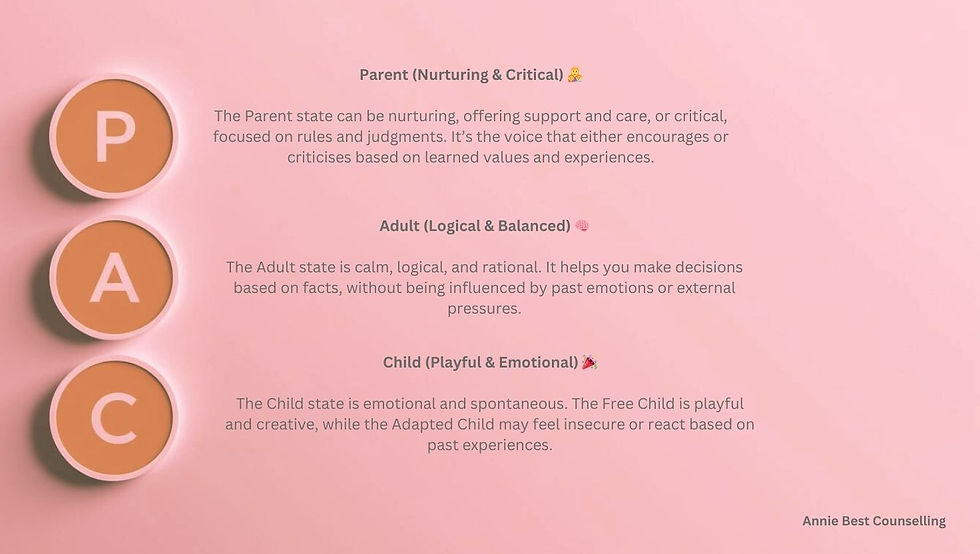
The PAC model is all about understanding the different states or "modes" we’re in when we communicate. We each switch between three different states depending on the situation:
Parent
Adult
Child
These aren’t literal "parent," "adult," and "child" in the way you might think, but rather they represent different ways we can show up emotionally and mentally. Understanding these can give you better insight into why you act and react the way you do. Ready? Let’s take a closer look.
The Parent State: Acting Like a Parent 👩👧👦
When we’re in our Parent state, we’re either acting like a caring, nurturing figure or like an authority figure who’s setting rules. It’s the part of us that’s shaped by our childhood and the values or rules we’ve learned from parents, teachers, and other authority figures.
Nurturing Parent: This side wants to care for others, protect them, and offer guidance. It’s that voice that says, “You’re doing great, keep going!” 😊
Critical Parent: This side can be more judgmental or controlling, saying things like, “You should have done this differently” or “Why didn’t you think about that?”
Example:If you’re talking to a friend about their career choice, the Nurturing Parent might say, “I think you’re doing an amazing job!” But the Critical Parent might say, “You really should have thought more about this decision.”
Being aware of these two sides helps you understand when you might be either overly supportive or too critical of yourself or others.
The Adult State: Logical and Balanced 🧠
When we’re in our Adult state, we’re calm, logical, and focused on facts. This part of us helps us make decisions based on what makes sense, rather than on emotions or old beliefs. It’s the part that’s able to look at things rationally and solve problems in a balanced way.
Example:Imagine you’re planning a holiday with a partner. The Adult state will help you take a step back and say, “Let’s check our budget and see what works for both of us,” or “We need to make sure we have enough time off to enjoy this properly.”
The Child State: Let’s Have Some Fun! 🎉
The Child state is all about emotions and energy. It’s where our inner child shows up—whether that's being playful and spontaneous, or feeling vulnerable and insecure. There are two sides to the Child state:
Free Child: The fun-loving, creative, carefree side of you. This part of you loves to laugh, explore, and be spontaneous. 🎨
Adapted Child: The side of you that’s more reactive. This part can feel insecure, anxious, or rebellious depending on past experiences.
Example:If you’re chatting with a friend and they bring up a tough situation at work, your Free Child might say, “I’m sure I can handle this! Let’s go have some fun tonight!” But if your Adapted Child shows up, you might feel anxious and say, “I can’t do this. I don’t think I’m good enough to make it work.”
So, How Does This All Help You? 🤷♀️
You might be thinking, “Okay, but how does this all help me in my day-to-day life?” Well, here’s how:
Better Self-Awareness: When you understand which state you’re in, you can better recognise why you might react a certain way. Are you acting too critical (Parent)? Or maybe you’re feeling overly emotional (Child)? Recognising this can help you shift gears and respond more thoughtfully.
Improved Communication: By understanding these different states, you can improve how you communicate with others. For example, if someone’s being overly critical (in their Parent state), you can shift into your Adult state and have a calm, balanced conversation.
More Balanced Relationships: The PAC model helps you understand the balance you need in your relationships. You’ll know when it’s time to nurture, when it’s time to be logical, and when it’s time to let loose and have fun! 😎
As a counsellor based in Basingstoke, I use the PAC model to help my clients understand their behaviour patterns and communication styles. Whether you’re feeling stuck in old habits, struggling with self-doubt, or just wanting to find better ways to connect with others, the PAC model can be a helpful tool for self-discovery and growth.
Through counselling, we can explore your Parent, Adult, and Child states to help you gain more control over your reactions, communicate more effectively, and build healthier relationships with yourself and others.
If you’d like to learn more about how this model can help you, or if you’re ready to start your counselling journey, I’d love to hear from you. You don’t have to go through this alone – I’m here to support you every step of the way. 🤝


Comments